Selasa, 27 Oktober 2009

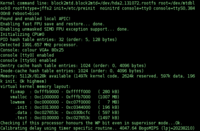
Linux kernel


The Linux kernel is an operating system kernel used by the Linux family of Unix-like operating systems. It is one of the most prominent examples of free and open source software.

The Linux kernel is released under the GNU General Public License version 2 (GPLv2) plus proprietary licenses for some controversial BLOBs and is developed by contributors worldwide. Day-to-day development takes place on the Linux kernel mailing list.

The Linux kernel was initially conceived and created by Finnish computer science student Linus Torvalds in 1991. Early on, the MINIX community contributed code and ideas to the Linux kernel. At the time, the GNU Project had created many of the components required for a free software operating system, but its own kernel, GNU Hurd, was incomplete and unavailable. The BSD operating system had not yet freed itself from legal encumbrances. This meant that despite the limited functionality of the early versions, Linux rapidly accumulated developers and users who adopted code from those projects for use with the new operating system. The Linux kernel has received contributions from thousands of programmers. Many Linux distributions have been released based upon the Linux kernel. (en.wikipedia.org)


LINUX


Linux (commonly pronounced /ˈlɪnʌks/, LI-nuks in English[4][5], also pronounced /ˈlɪnʊks/) is a generic term referring to Unix-like computer operating systems based on the Linux kernel. Their development is one of the most prominent examples of free and open source software collaboration; typically all the underlying source code can be used, freely modified, and redistributed, both commercially and non-commercially, by anyone under the terms of the GNU GPL.
Linux is predominantly known for its use in servers, although can be installed on a wide variety of computer hardware, ranging from embedded devices, mobile phones and even some watches to supercomputers. Linux distributions, installed on both desktop and laptop computers, have become increasingly commonplace in recent years, partly owing to the popular Ubuntu distribution and the emergence of netbooks.
The name "Linux" comes from the Linux kernel, originally written in 1991 by Linus Torvalds. The rest of the system usually comprises components such as the Apache HTTP Server, the X Window System, the GNOME and KDE desktop environments, and utilities and libraries from the GNU Project (announced in 1983 by Richard Stallman). Commonly-used applications with desktop Linux systems include the Mozilla Firefox web-browser and the OpenOffice.org office application suite. The GNU contribution is the basis for the Free Software Foundation's preferred name GNU/Linux.
Unix
The Unix operating system was conceived and implemented in 1969 at AT&T's Bell Laboratories in the United States by Ken Thompson, Dennis Ritchie, Douglas McIlroy, and Joe Ossanna and first released in 1971. Unix was written in assembly language and later re-written in C in 1973 by Dennis Ritchie. Its wide availability and portability due to being written in C meant that it was widely adopted, copied and modified by academic institutions and businesses, with its design being influential on authors of other systems.
GNU
The GNU Project, started in 1983 by Richard Stallman, had the goal of creating a "complete Unix-compatible software system" composed entirely of free software. Work began in 1984. Later, in 1985, Stallman created the Free Software Foundation and wrote the GNU General Public License (GNU GPL) in 1989. By the early 1990s, many of the programs required in an operating system (such as libraries, compilers, text editors, a Unix shell, and a windowing system) were completed, although low-level elements such as device drivers, daemons, and the kernel were stalled and incomplete. Linus Torvalds has said that if the GNU kernel had been available at the time (1991), he would not have decided to write his own. (en.wikipedia.org)


Windows 7


Windows 7 is the latest version of Microsoft Windows, a series of operating systems produced by Microsoft for use on personal computers, including home and business desktops, laptops, netbooks, tablet PCs and media center PCs. Windows 7 was released to manufacturing on July 22, 2009, and general retail availability on October 22, 2009, less than three years after the release of its predecessor, Windows Vista. Windows 7's server counterpart, Windows Server 2008 R2, was released at the same time.
Unlike its predecessor, which introduced a large number of new features, Windows 7 is intended to be a more focused, incremental upgrade to the Windows line, with the goal of being fully compatible with applications and hardware with which Windows Vista is already compatible. Presentations given by Microsoft in 2008 focused on multi-touch support, a redesigned Windows Shell with a new taskbar, referred to as the Superbar, a home networking system called HomeGroup, and performance improvements. Some applications that have been included with prior releases of Microsoft Windows, including Windows Calendar, Windows Mail, Windows Movie Maker, and Windows Photo Gallery, are not included in Windows 7; some are instead offered separately as part of the free Windows Live Essentials suite.
Main article: Features new to Windows 7
Windows 7 includes a number of new features, such as advances in touch and handwriting recognition, support for virtual hard disks, improved performance on multi-core processors, improved boot performance, DirectAccess, and kernel improvements. Windows 7 adds support for systems using multiple heterogeneous graphics cards from different vendors (Heterogeneous Multi-adapter), a new version of Windows Media Center, a Gadget for Windows Media Center, improved media features, the XPS Essentials Pack and Windows PowerShell being included, and a redesigned Calculator with multiline capabilities including Programmer and Statistics modes along with unit conversion. Many new items have been added to the Control Panel, including ClearType Text Tuner, Display Color Calibration Wizard, Gadgets, Recovery, Troubleshooting, Workspaces Center, Location and Other Sensors, Credential Manager, Biometric Devices, System Icons, and Display. Windows Security Center has been renamed to Windows Action Center (Windows Health Center and Windows Solution Center in earlier builds), which encompasses both security and maintenance of the computer. The default setting for User Account Control in Windows 7 has been criticized for allowing untrusted software to be launched with elevated privileges by exploiting a trusted application. Microsoft's Windows kernel engineer Mark Russinovich acknowledged the problem, but noted that there are other vulnerabilities that do not rely on the new setting. Windows 7 also supports Mac-like RAW image viewing through the addition of WIC-enabled image decoders, which enables raw image thumbnails, previewing and metadata display in Windows Explorer, plus full-size viewing and slideshows in Windows Photo Viewer and Window Media Center. 
(en.wikipedia.org)


Sabtu, 24 Oktober 2009

Office 2010 Memasuki Versi Beta


Bersamaan dengan diumumkannya Visual Studio 2010 kemarin (19/10/09), Microsoft juga mengumumkan bahwa akan segera merilis versi beta dari Office 2010 bulan November 2009 mendatang.

Pengembang aplikasi telah merilis preview dari teknologi-teknologi yang cukup dibatasi pada bulan Juli lalu dan merencanakan akan merilis versi finalnya pada tahun depan. Selain itu juga, pengembang telah memulai untuk uji coba versi web based “Office Web Apps” pada bulan September 2009 lalu.

Pada konferensi SharePoint tersebut juga mengutarakan beberapa fitur baru dari generasi baru aplikasi portal tersebut yang mana bulan depan akan memasuki versi beta-nya.

Versi terbaru ini meliputi Office Ribbon User Interface yang mana sudah mendukung penggunaan video, audio dan Silverlight. Para programmer juga akan mengembangkan website Sharepoint menggunakan generasi terbaru dari Visual Studio, yang mana akan memasuki versi beta pada minggu ini juga.

Sharepoint adalah produk utama dari Microsoft sebagai salah satu perusahaan yang cepat berkembang pesat dengan bisnis yang telah menghasilkan 1.3 milyar dolar dan telah naik hingga 20 persen keuntungannya untuk 1 tahun belakangan ini.

“SharePoint 2010 adalah yang terbesar dan paling utama untuk dirilis,” kata CEO Microsoft, Steve Ballmer. “Ketika dipasangkan dengan Microsoft Office 2010, SharePoint 2010 akan bertransformasi dengan lebih efisien dengan cara mengkoneksikan para pekerja dengan satu platform khusus untuk kolaborasi bagi bisnis besar nantinya.” (beritateknologi.com)

Jumat, 23 Oktober 2009

Ubuntu 9.10 Release Candidate


Peluncuran software open source Ubuntu 9.10 Release Candidate (RC) oleh Canonical, ternyata bersamaan dengan launching system operasi terbaru dari Microsoft, Windows 7. Pada Kamis (22/10) lalu, Canonical merilis system operasi yang pernah dijuluki Karmic Koala tersebut, dan satu pengembangan lebih lanjut untuk ke versi final mulai tanggal 29 Oktober mendatang.
Uji coba Karmic Koala RC tersebut dapat di-download untuk server, desktop dan versi netbook, melalui website Ubuntu (releases.ubuntu.com/releases/9.10). Untuk Ubuntu 9.10 RC versi desktop juga dapat di-instal di standard laptop. Software Ubuntu 9.10 RC ini merupakan upgrade dari versi sebelumnya Ubuntu 9.04, yang membawa kode Jaunty Jackalope.

Dibangun di kernel Linux terbaru Linux 2.6.31.1 kernel, Ubuntu 9.10 RC menawarkan booting time lebih cepat, improvisasi interface dan tool programming dengan variasi lingkungan grafis desktop.Grafis desktop termasuk integrasi software IM (Instant-Messaging), browser web, document viewer, dan software multimedia.

Software Karmic Koala ini dilengkapi dengan tool baru bernama "Ubuntu Software Center" yang memudahkan user untuk menghapus atau menambah program, sama halnya seperti di Windows. System operasi ini juga telah memperbaiki banyak bug dari edisi Ubuntu sebelumnya dan support driver untuk tambahan hardware. Canonical menyiapkan penyimpanan online dan layanan file-sharing bernama Ubuntu One, yang ada di Ubuntu 9.10 RC. User dapat backup, share atau sinkronisasi data melalui website Ubuntu One (one.ubuntu.com). Layanan tersebut memiliki kapasitas penyimpanan online 2GB gratis untuk pengguna Ubuntu, dan tambahan kapasitas 50GB dengan harga $10 per bulan. (beritanet.com)
hostgator coupon